
Cyberattacks are rarely treated as what they are: a human rights crisis. One patient. One school. One town without water. On their own, each looks like an isolated incident.
Examined together, they reveal a pattern across ten sectors people depend on to live, work, and stay safe.
Frontline is the evidence base for advancing accountability.
Frontlines
Scale of Harm
Healthcare
Hospitals run on systems that cannot go down without a direct impact on patients. Healthcare now absorbs more ransomware attacks than almost any other sector.
410 ransomware attacks hit healthcare organizations worldwide in the first half of 2026 alone, up 14% from the prior half. *
Energy
Power grids supply every other system on this list, from hospitals to water treatment. A single intrusion can cascade across sectors that depend on it.
Ransomware attacks on the utilities sector are up 80% since 2023. *
Water
Water utilities are often small and underfunded, never built to withstand a deliberate attack. In July 2026, hackers breached internet-exposed systems across a dozen U.S. states, forcing towns to divert to manual control.
More than 100 internet-exposed water and wastewater systems were targeted in a single month.*
Communications
Telecom networks carry emergency calls, banking, and crisis coordination. When a network goes down, everything depending on it goes dark too.
Attacks on telecom networks have nearly quadrupled since 2022, reaching 90 confirmed incidents in 2025.*
Transportation
Ports, airports, and rail systems still run on infrastructure built decades before cybersecurity was a design consideration. A single breach can strand cargo and passengers across an entire network.
Cyberattacks on global logistics are up nearly 1,000% since 2021, and are expected to double again in 2026. *
Manufacturing
Manufacturing runs on tightly linked supply chains. A single breach rarely stays with one company; it ripples through everyone downstream.
1,183 disclosed victims were recorded in manufacturing worldwide in the first seven months of 2026. *
Government
Municipal governments run services people cannot opt out of — permits, courts, utilities billing — often on outdated systems with minimal security staff.
Attacks on government and business entities rose 12% globally in the first half of 2026. *
Finance
Financial institutions hold the systems people depend on for savings, payments and daily transactions. Few sectors are targeted as consistently.
Ransomware victims in financial services rose 27% between April 2025 and March 2026. *
We document these impacts through firsthand testimony, sector by sector, until the pattern is impossible to dismiss.
A pattern builds a case for reform.
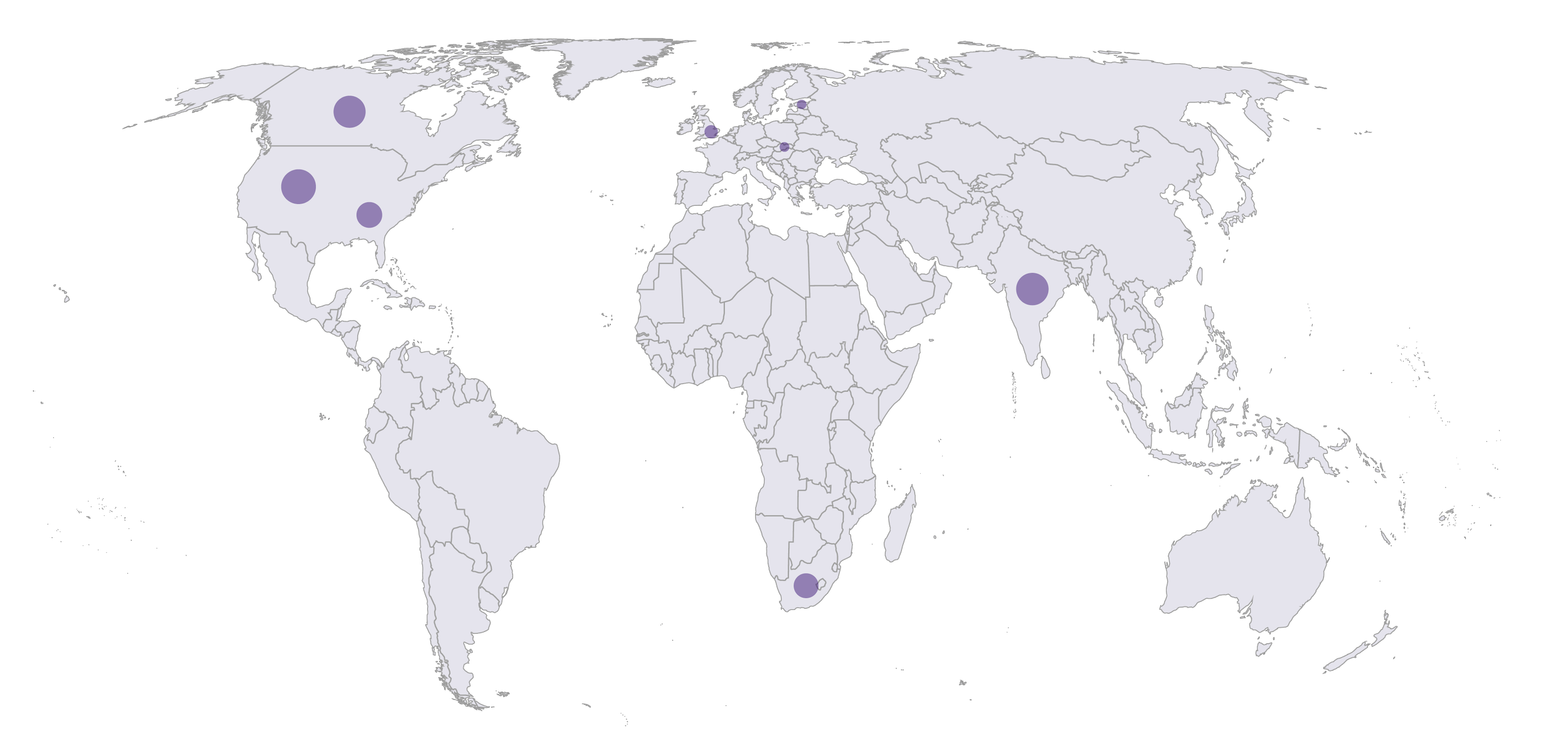
Reference: UN Geospatial; Version: 01 July 2026