
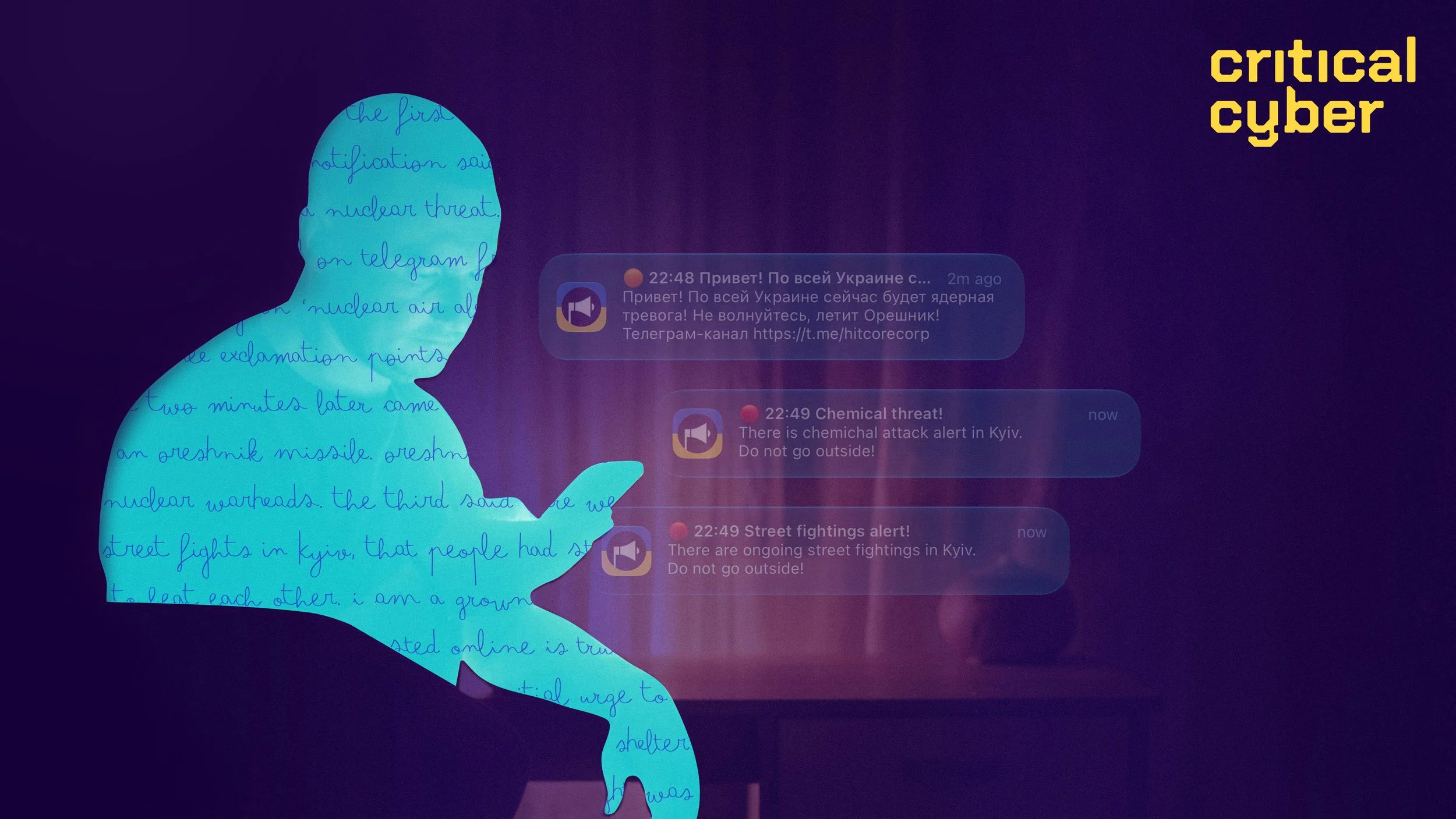
At 22:47 on 1 November 2026, phones across Ukraine began to light up. Within about seven minutes, the air alert app that millions rely on had sent 122 false warnings: radiation, a chemical attack, street fighting in Kyiv, an Oreshnik missile carrying a nuclear warhead, some of them written in Russian. Fedir is an international lawyer who has lived in Kyiv since 2020. For him, the app is the most reliable source of information about air alerts. Here he recalls the night when the app was hacked, and lied.
“Your heart starts beating faster. You turn from regular mode into survival mode.”
“Until recently, we had several air alerts a day. Twelve to thirty minutes, depending on the weapon. In Ukraine, all institutions, shops and businesses have to stop working during an alert, so everything is suspended. Then, starting in September, the Russians began to use jet-powered Shaheds, the Gerans. With those, one alert can last an hour or longer. That is very disruptive for any sphere. Kindergartens, schools: the kids go to the basement and lessons stop. You cannot go and buy groceries.
Then the government introduced a graduated approach around October. Like a traffic light. Yellow means the danger comes only from the jet-powered drones, red means a ballistic threat. For that, they use a mobile application, a map showing the particular types of threat. Two weeks ago it started showing the actual location of the drones, so you can predict when the alert will reach your city. At school you can opt for a longer break between lessons if you see the Shaheds approaching. It was developed as a private initiative, and then the government picked it up and started using it. A lot of people trust it. Over 90 percent of people in Ukraine have smartphones, and even older persons use it now.
On a normal working day, from nine to six, I go to the shelter four or five times. You pack your laptop, the alert is on, you go downstairs, and then you pack it back. Earlier, TV and radio were the reliable sources. Now it is the mobile phone, with you 24/7. Sometimes you miss the threats because you are fast asleep. Sometimes you already hear explosions.
Sunday evening, around half past ten, I was standing in the bathroom, shaving, with the phone lying not far from me. The first notification said there was a nuclear threat.
Then a message arrived on Telegram from a friend who had just typed in ‘nuclear air alert’, and three exclamation points.
Two minutes later came the second one, about an Oreshnik missile. Oreshnik is able to carry nuclear warheads. The third said there were street fights in Kyiv, that people had started to beat each other.
I am a grown man. I understand that not everything posted online is true. Still, it was difficult to minimise that initial urge to start panicking, to look for options, for where to go to seek shelter against nuclear weapons. My first thought was this: I had opened my windows, so I had better close them, because otherwise nuclear materials might get into the room. I was calm, but your heart starts beating faster. You turn from regular mode into survival mode.
Five or ten minutes later, I found out the application had been hacked, and that it was disinformation. For me it was easy to verify, because there were messages on Telegram saying that. The first notification came in Ukrainian. The Oreshnik one came in Russian. And on the map where you can see the drones, they had put the Z and V, the Russian occupation insignia. They thought it was funny. It is a kind of joke to them.
But I was also thinking that not all older people use Telegram. Not all of them are digitally savvy. For them, these minutes could have lasted half an hour or an hour, until they called relatives who could verify that it did not actually happen: ‘Everything is fine, calm down, go to bed, it is already late evening.’ I can only imagine the effect on people who trust this application as a verified source, as a government source about threats. It was stressful for me. I can only imagine the level of stress for others.
The next day I talked with colleagues in the office. Some said they were not impacted. Some said it fitted so organically into the whole picture of disinformation: first the nuclear threats, then the use of Oreshnik without nuclear warheads, and now suddenly the idea of actual nuclear warheads, an extra step in escalation. One colleague told me she felt powerless: if it comes, it comes, embrace your destiny. Another said she felt pretty nervous. She remembered Chernobyl, when we did not receive any information about what was going on, and she thought the government might try to hide something. That is illogical, because the notification was right there on the phone. But there is a certain level of perceived distrust.
Maybe the impact cannot be compared to an attack on a bank, when you lose your savings. But it has a significant impact because of its scale: so many people hit by one attack, even for a short period of time. In my view, it was a kind of successful attack. It is relatively cheap, but the outcome is instability, these thoughts of a possible nuclear attack.
People are already tired. Attacks happen not only during the night but also during the day, and this kind of digital thing is usually preparing the ground. At some point a person becomes so tired that he or she does not treat personal safety as such a serious thing. It is like the boy who cried wolf. The pressure turns into reluctance to take action, and this reluctance sometimes can cost lives. People become tired, and they stop taking precautions to protect themselves.
I will continue using this application, because I do not have a lot of options. But when I see information outside the pattern, I will start verifying it, checking Telegram and other sources. I do not know the authors, but when you follow a channel for some time, you understand that they have pretty accurate information, and you start trusting.
What would help is open communication from the administrator of the application. If they show the whole way it was done, and what additional measures they are taking to protect it from future attacks, it would help me trust them again. I would see that some lessons are learned and that we are more protected than we used to be.
Here in Kyiv, we at least have notifications, and some time to go and seek shelter. In towns closer to the border, people do not have such time. They just continue doing their thing, hoping it will land not near them.”
Fedir, Ukraine
